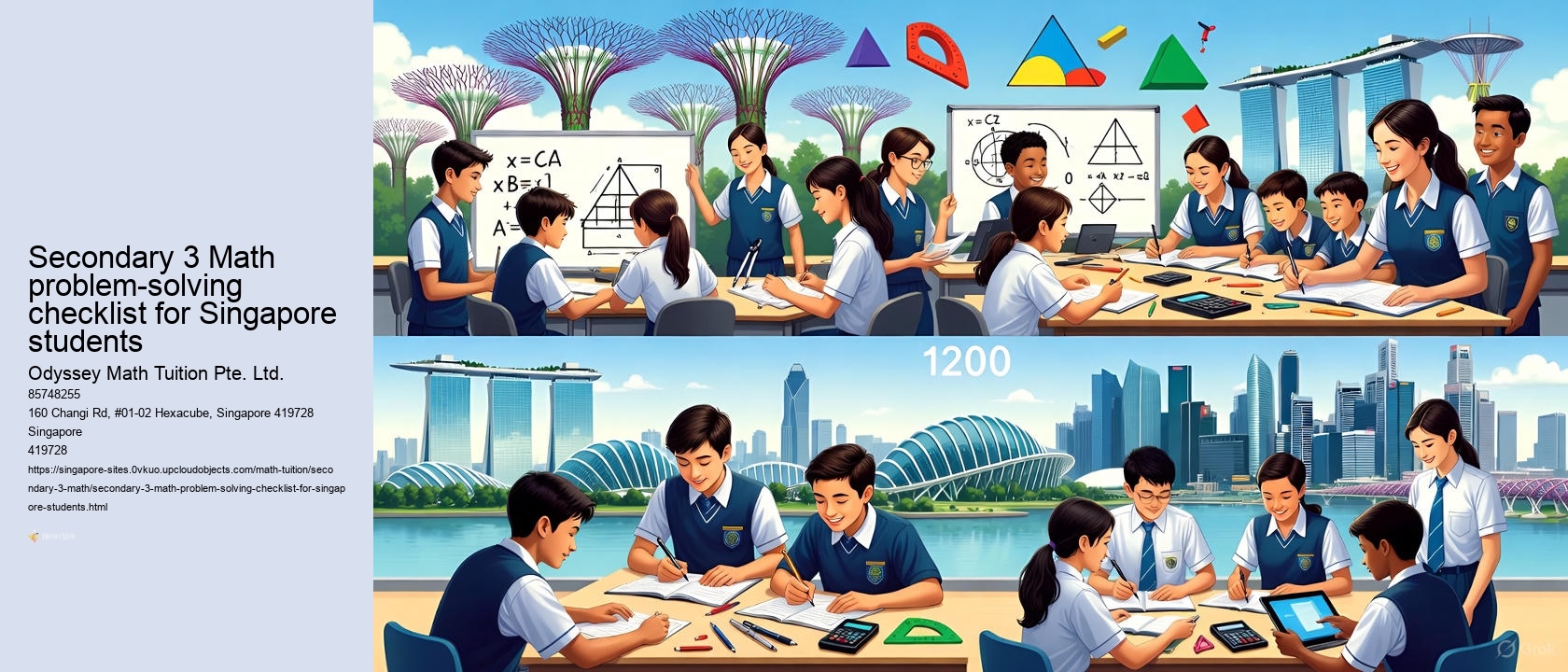
Secondary 3 Math problem-solving checklist for Singapore students
Understanding the Sec 3 Math Syllabus: A Roadmap to Success
Alright, parents and students, listen up! Secondary 3 Math revision checklist for Singapore students . In today's fast-paced educational scene, many parents in Singapore are seeking effective strategies to boost their children's comprehension of mathematical concepts, from basic arithmetic to advanced problem-solving. Establishing a strong foundation early on can substantially improve confidence and academic success, helping students tackle school exams and real-world applications with ease. For those exploring options like secondary 3 math it's essential to focus on programs that stress personalized learning and experienced instruction. This approach not only addresses individual weaknesses but also fosters a love for the subject, leading to long-term success in STEM-related fields and beyond.. Secondary 3 Math – it's not just about scoring well now, ah? It's the foundation for everything later. Think JC, poly, university… and even your dream job! In this era of AI, mathematics is no longer just a subject, but a fundamental language to survive and excel.
Secondary 3 Math Problem-Solving Checklist: Your Secret Weapon
Okay, so you want to really nail Secondary 3 Math? Not just pass, but ace it? Then this checklist is your 'kopi-o' – your reliable boost! This is your guide on how to excel in Singapore Secondary 3 Math.
1. Know Your Enemy (a.k.a. The Syllabus)
First things first, you need to understand the Secondary 3 Math Syllabus Overview. What are you even fighting against?
Algebra: This is where you wrestle with equations, inequalities, and graphs. Think simultaneous equations, quadratic equations, and manipulating algebraic expressions like a pro. No slacking here, okay?
Subtopic: Mastering Quadratic Equations: Learn how to solve quadratic equations using various methods, including factorization, completing the square, and the quadratic formula. Know when to use each method!
Geometry & Trigonometry: Get ready to explore shapes, angles, and their relationships. Pythagoras Theorem, trigonometry ratios (sine, cosine, tangent), and geometric proofs are your new best friends.
Subtopic: Applying Trigonometry to Real-World Problems: Learn how to use trigonometry to solve real-world problems involving angles of elevation and depression, bearings, and distances.
Statistics & Probability: Time to analyze data and predict outcomes. Mean, median, mode, probability, and data representation (histograms, pie charts) are all part of the game.
Subtopic: Understanding Probability Distributions: Learn about different types of probability distributions, such as the normal distribution and the binomial distribution, and how to use them to calculate probabilities.
Fun Fact: Did you know that trigonometry can be traced back to ancient Egypt and Babylon? They used it for surveying land and building pyramids! So smart, right?
2. Practice Makes Perfect (Seriously!)
This isn't just some saying your grandma tells you. In Math, it's gospel.
Past Year Papers (PYP): These are your 'holy grail'. Do them. All of them. Multiple times. Understand the marking scheme. See how the questions are structured. This is key on how to excel in Singapore Secondary 3 Math.
Textbook Exercises: Don't skip these! They build the foundation. Even if you think they're 'easy peasy', do them for the practice.
Assessment Books: Find one that suits your learning style. Some are more challenging, some are more straightforward. Find your fit!
3. Understand, Don't Memorize (The Singapore Way)
Singaporean parents, I know you want your kids to memorize formulas, but trust me, understanding is more important.
Why does this formula work? Don't just blindly apply it. Understand the concept behind it.
Can I derive the formula myself? If you can, you're golden!
How does this concept relate to other concepts? Math is interconnected. See the bigger picture.
Interesting Fact: The concept of zero, so crucial in algebra, wasn't always around! In the city-state's challenging education structure, parents fulfill a vital part in leading their kids through key evaluations that form academic futures, from the Primary School Leaving Examination (PSLE) which assesses basic competencies in areas like numeracy and science, to the GCE O-Level exams concentrating on high school mastery in multiple subjects. As pupils move forward, the GCE A-Level examinations require more profound critical abilities and subject command, commonly influencing university entries and career directions. To remain updated on all aspects of these national assessments, parents should explore official resources on Singapore test papers offered by the Singapore Examinations and Assessment Board (SEAB). This secures entry to the latest syllabi, assessment schedules, sign-up information, and instructions that correspond with Ministry of Education criteria. Regularly referring to SEAB can assist households prepare successfully, minimize doubts, and bolster their kids in reaching optimal outcomes during the demanding scene.. It took centuries for mathematicians to fully grasp its significance. Imagine doing math without zero! Headache, right?
4. Seek Help When Needed (Don't be 'Paiseh'!)
No one expects you to be a Math genius overnight.
Ask your teachers: They're there to help! Don't be afraid to ask questions in class or during consultation.
Form a study group: Misery loves company! (Just kidding!) But seriously, studying with friends can be helpful. You can learn from each other and explain concepts to each other.
Consider tuition: If you're really struggling, tuition can provide personalized attention and help you catch up. It's an investment in your future, lah! Look for tutors experienced in guiding students on how to excel in Singapore Secondary 3 Math.
5. Exam Strategies (The 'Kiasu' Approach)
Okay, Singaporean parents, this is where your 'kiasu' spirit comes in handy!
Time Management: Practice solving problems under timed conditions. Learn to allocate your time wisely during the exam.
Show Your Working: Even if you get the wrong answer, you can still get partial credit for showing your working.
Check Your Answers: Don't just submit your paper and run! Take the time to check your answers. It can save you from careless mistakes.
In the demanding world of Singapore's education system, parents are progressively concentrated on equipping their children with the abilities essential to excel in intensive math syllabi, encompassing PSLE, O-Level, and A-Level exams. Identifying early indicators of difficulty in areas like algebra, geometry, or calculus can create a world of difference in fostering resilience and expertise over intricate problem-solving. Exploring trustworthy math tuition Singapore options can deliver tailored assistance that matches with the national syllabus, ensuring students acquire the edge they require for top exam performances. By prioritizing dynamic sessions and steady practice, families can help their kids not only achieve but go beyond academic standards, clearing the way for prospective possibilities in high-stakes fields..
History Moment: The word "algebra" comes from the Arabic word "al-jabr," meaning "the reunion of broken parts." See? Even the name suggests putting things together!
6. The AI Advantage
In this age of Artificial Intelligence, having a solid grasp of mathematics is more critical than ever. AI thrives on algorithms and data analysis – all rooted in mathematical principles. A strong foundation in math equips you with the ability to:
Understand AI concepts: AI is not magic; it's math.
Adapt to technological advancements: Math skills are transferable and applicable across various fields.
Future-proof your career: The demand for math-savvy professionals will only increase.
So, parents, by investing in your child's math education, you're setting them up for success in a future dominated by AI. Students, embrace the challenge and see math as a tool to unlock endless possibilities!
By following this checklist, you'll be well on your way to acing Secondary 3 Math and paving the way for a bright future. Remember, it's not just about the grades; it's about developing problem-solving skills, critical thinking, and a love for learning. Can do, lah!
How can I help my Secondary 3 child improve their problem-solving skills in Math?
Encourage consistent practice with diverse problem types, focusing on understanding concepts rather than memorizing formulas. Consider seeking help from a qualified Math tutor if your child struggles.
What are the key topics in Secondary 3 Math that require strong problem-solving skills?
Algebra (equations, inequalities), Geometry (trigonometry, circles), and Statistics (probability) are key areas. Mastering these topics is crucial for success.
How important is it for my child to show their working steps in Math problem-solving?
Showing working steps is extremely important. It allows teachers to understand your childs thought process, award partial credit even with incorrect answers, and identify areas where your child needs help.
What resources are available to help my child practice problem-solving in Secondary 3 Math?
Utilize textbooks, assessment books, past year exam papers, and online resources like Khan Academy and educational websites specific to the Singapore Math curriculum.
How can I encourage my child to persevere when they encounter difficult Math problems?
Emphasize a growth mindset, praising effort and persistence rather than just innate ability. Break down problems into smaller, manageable steps, and celebrate small victories.
Should my child focus on memorizing formulas or understanding the underlying concepts?
Understanding the underlying concepts is far more important than memorizing formulas. Conceptual understanding allows for flexible application of knowledge to different problem types.
What role does time management play in solving Math problems during exams?
Effective time management is crucial. Encourage your child to allocate time for each question, prioritize easier questions first, and avoid spending too much time on a single difficult problem.
How can a Math tutor help my Secondary 3 child with problem-solving?
A Math tutor can provide personalized instruction, identify knowledge gaps, offer targeted practice, and explain concepts in a way that resonates with your childs learning style, ultimately improving their problem-solving abilities.