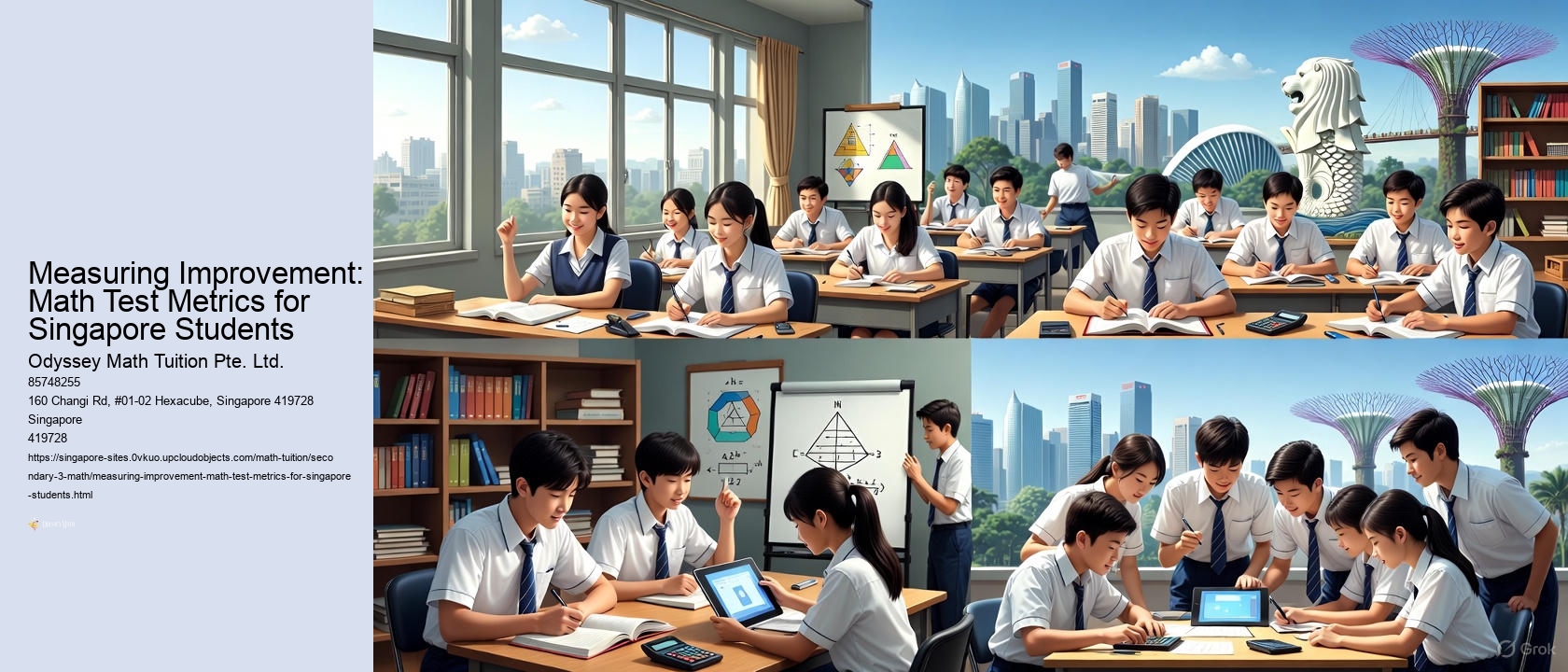
Measuring Improvement: Math Test Metrics for Singapore Students
Introduction: Beyond Grades – Understanding Math Improvement
Alright, parents and Sec 3 students, let's talk about Math. In Singapore, it's not just about getting that A1, lah. It's about truly understanding the concepts, the 'why' behind the 'how'. Because let's be real, in this AI-driven world, Math isn't just a subject; it's a superpower! It's the foundation for everything from coding your own AI assistant to understanding complex financial models. So, how do we know if our kids (or ourselves!) are really improving in Math, beyond just staring at that final grade?
See, relying solely on the final grade is like judging a nasi lemak based only on the rice – you're missing the whole picture! You need the chicken wing, the sambal, the ikan bilis… the *oomph*! In Singapore's demanding education system, parents fulfill a essential role in guiding their kids through key tests that influence scholastic trajectories, from the Primary School Leaving Examination (PSLE) which tests basic abilities in disciplines like math and science, to the GCE O-Level tests concentrating on secondary-level mastery in diverse disciplines. In today's competitive educational environment, many parents in Singapore are looking into effective ways to boost their children's comprehension of mathematical concepts, from basic arithmetic to advanced problem-solving. Creating a strong foundation early on can greatly boost confidence and academic performance, helping students handle school exams and real-world applications with ease. For those investigating options like secondary 3 math it's essential to prioritize on programs that emphasize personalized learning and experienced instruction. This method not only tackles individual weaknesses but also fosters a love for the subject, resulting to long-term success in STEM-related fields and beyond.. As learners advance, the GCE A-Level assessments necessitate more profound critical capabilities and discipline command, frequently determining tertiary admissions and professional paths. To keep well-informed on all aspects of these national exams, parents should investigate authorized resources on Singapore test papers provided by the Singapore Examinations and Assessment Board (SEAB). This guarantees availability to the newest programs, examination timetables, registration details, and standards that align with Ministry of Education criteria. Consistently consulting SEAB can aid parents plan effectively, reduce ambiguities, and support their offspring in attaining optimal outcomes amid the demanding environment.. Similarly, in Math, you need to look at specific metrics within the tests to truly gauge progress. We're talking about going beyond just "pass" or "fail" and diving deep into the data. This is how to excel in Singapore Secondary 3 Math – by understanding the nuances of your performance.
Think of it this way: a student might score well on a test simply because they memorized formulas. But can they apply those formulas to new, unfamiliar problems? Can they explain the underlying concepts? That's where the real understanding lies, and that's what these metrics help us uncover. This is a proven method on how to excel in Singapore Secondary 3 Math
Fun Fact: Did you know that the word "algebra" comes from the Arabic word "al-jabr," meaning "the reunion of broken parts"? It's like putting the puzzle pieces of a problem back together! Understanding the history sometimes helps appreciate the subject more!
Measuring Improvement: Math Test Metrics for Singapore Students
So, what metrics should we be looking at? Here are a few key areas:
Accuracy Rate by Topic: This breaks down your performance in each specific area of the syllabus. Are you consistently acing Algebra but struggling with Geometry? This pinpointed information helps you focus your study efforts effectively.
Types of Errors: Are you making careless mistakes (like forgetting a minus sign) or conceptual errors (misunderstanding a core principle)? Identifying the *type* of error is crucial for targeted improvement.
Time Management: Are you rushing through certain sections and running out of time? This could indicate a lack of fluency or difficulty with specific problem-solving techniques.
Problem-Solving Strategies: Are you consistently using the most efficient methods to solve problems? Or are you relying on slower, more cumbersome approaches?
By tracking these metrics, you get a much clearer picture of your strengths and weaknesses, allowing you to create a more effective study plan. This is super useful for secondary 3 students who are preparing for their O-Levels!
Common Mistakes and How to Avoid Them
Okay, let's be honest, everyone makes mistakes. But the key is to learn from them! Here are some common pitfalls that Singaporean Sec 3 students often encounter in Math, and how to dodge them:
Rote Memorization: Just memorizing formulas without understanding the concepts is a recipe for disaster. Instead, focus on understanding the *why* behind the formulas.
Neglecting the Fundamentals: A weak foundation in basic concepts can lead to problems down the line. Make sure you've mastered the fundamentals before moving on to more advanced topics.
Lack of Practice: Math is like riding a bicycle – you need to practice to stay sharp! In the demanding world of Singapore's education system, parents are increasingly concentrated on arming their children with the abilities needed to thrive in intensive math curricula, including PSLE, O-Level, and A-Level exams. Identifying early indicators of difficulty in areas like algebra, geometry, or calculus can bring a world of difference in building resilience and proficiency over intricate problem-solving. Exploring dependable math tuition Singapore options can deliver personalized assistance that corresponds with the national syllabus, making sure students gain the boost they require for top exam performances. By focusing on dynamic sessions and regular practice, families can assist their kids not only achieve but exceed academic expectations, opening the way for future chances in competitive fields.. Solve a variety of problems regularly to build your skills and confidence.
Not Showing Your Work: Skipping steps in your working can lead to careless errors and make it difficult to track down mistakes. Always show your full working!
Where applicable, add subtopics like:
Specific Error Analysis:
Delve deeper into the types of errors made. Are they related to sign errors, misapplication of formulas, or misunderstanding of the question's requirements? Categorizing mistakes is the first step to rectifying them.
Targeted Practice:
Once you've identified your weaknesses, focus on practicing those specific areas. Use past year papers, textbooks, and online resources to hone your skills. Consider seeking guidance from a tutor for personalized support.
Conceptual Clarity:
If you're struggling with a particular concept, don't be afraid to ask for help. Talk to your teacher, classmates, or a tutor. There are also plenty of online resources, such as videos and tutorials, that can help you understand the concepts better.
Interesting Fact: The concept of zero, which is so fundamental to mathematics, wasn't widely accepted in Europe until the 12th century! Imagine doing algebra without zero!
So, there you have it! By focusing on these metrics and avoiding common mistakes, you can unlock your full potential in Math and set yourself up for success in secondary school and beyond. Remember, it's not just about the grades; it's about the journey of learning and growing. Now go forth and conquer those Math problems, Singapore!