Criteria for Evaluating Your Child's Study Environment
Introduction: The Crucial Role of Study Environment
Alright, parents and Sec 3 students, let's talk about your study space. In Singapore, where the competition is, shall we say, *intense*, having a good study environment is not just a 'nice to have' – it's a *must-have* if you want to conquer those challenging subjects, especially Mathematics. Learning how to excel in Singapore Secondary 3 Math isn't just about mugging; it's about setting yourself up for success. Think of it as planting the seed in fertile ground – you need the right conditions for it to flourish!
We all know how important Math is, right? It's not just about acing your 'O' Levels; it's about building a solid foundation for your future. And with AI becoming more and more prevalent, understanding the logic and problem-solving skills that Math provides is super important. In today's demanding educational landscape, many parents in Singapore are seeking effective ways to boost their children's understanding of mathematical concepts, from basic arithmetic to advanced problem-solving. Establishing a strong foundation early on can substantially elevate confidence and academic achievement, aiding students conquer school exams and real-world applications with ease. For those considering options like secondary 3 math it's crucial to concentrate on programs that stress personalized learning and experienced guidance. This approach not only resolves individual weaknesses but also nurtures a love for the subject, resulting to long-term success in STEM-related fields and beyond.. Plus, let's be honest, a strong Math background opens doors to *so* many careers – from engineering to finance to even data science! Don't play play!
Creating a Conducive Study Environment
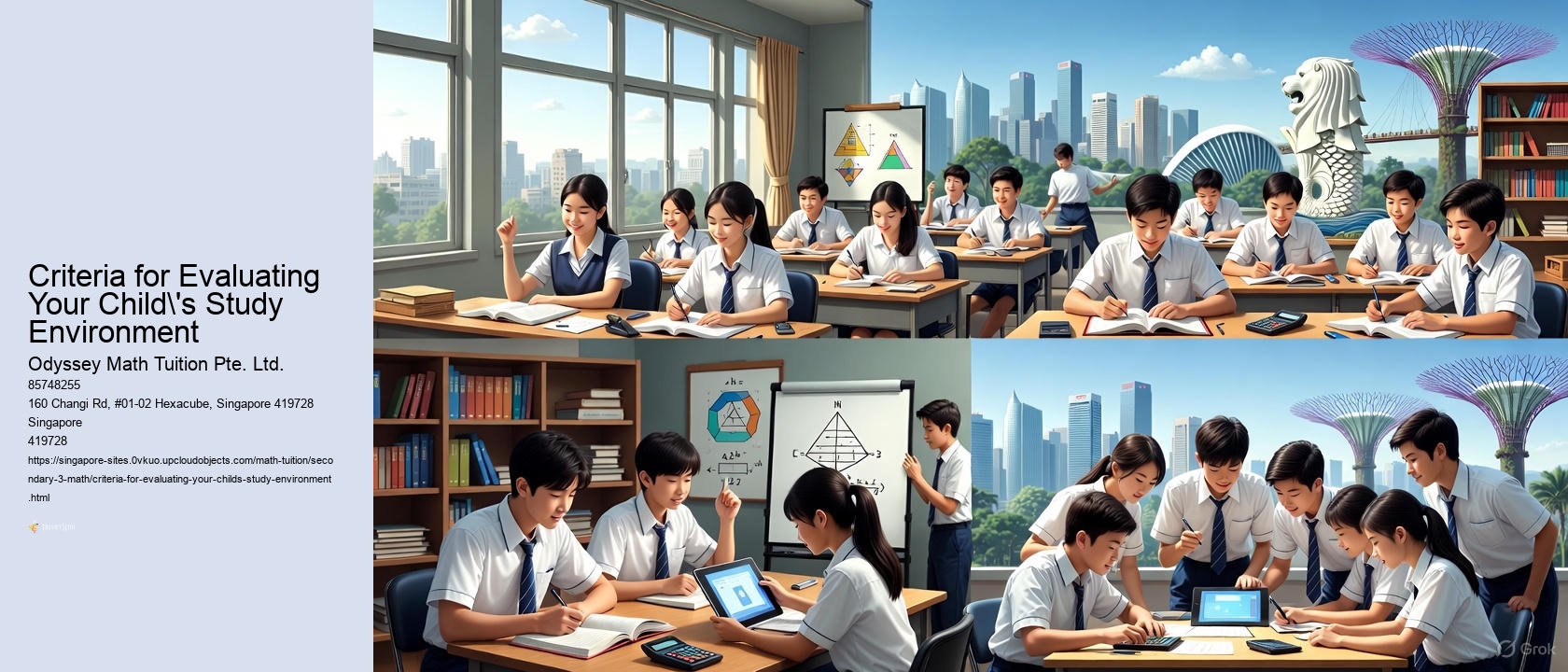
So, what exactly makes a *good* study environment? It's not just about having a desk and a chair, okay? It's about creating a space that's conducive to focused learning, minimizes distractions, and supports your child's (or your own!) well-being. Here's the thing: a good study environment can significantly impact how well your child learns and retains information. Think of it as the difference between trying to study in a noisy hawker centre versus a quiet library. Which one do you think will help you ace your exams?
Subtopics to consider:
1. Location, Location, Location!
Find a spot that's away from the main action. The living room might be comfy, but it's also where the TV is, and where everyone gathers. A quiet corner in the bedroom, or even a dedicated study room if you have one, is ideal. Make sure it's a place where your child can focus without being constantly interrupted. This is the first step how to excel in Singapore Secondary 3 Math.
2. The Power of Organisation
A cluttered space equals a cluttered mind, right? Encourage your child to keep their study area tidy and organized. This means having a system for storing books, notes, and stationery. Invest in some shelves, drawers, or even just some organizers to keep everything in its place. A clean and organized space will help your child focus and be more productive. So important!
3. Lighting and Ergonomics
Good lighting is crucial to prevent eye strain and fatigue. Natural light is best, but if that's not possible, make sure to have a good desk lamp that provides adequate illumination. And don't forget about ergonomics! Make sure your child has a comfortable chair that supports their back, and that their desk is at the right height. Sitting in an uncomfortable position for hours on end can lead to aches and pains, which will definitely affect their concentration.
4. Minimizing Distractions
This is a big one! In today's world, there are distractions everywhere, from smartphones to social media to video games. Work with your child to create a distraction-free zone. This might mean turning off notifications on their phone, using website blockers to limit access to social media, or even just putting their phone in another room while they're studying. In the challenging world of Singapore's education system, parents are ever more focused on preparing their children with the skills essential to excel in rigorous math curricula, including PSLE, O-Level, and A-Level exams. In this nation's demanding education structure, parents fulfill a crucial part in guiding their kids through key assessments that form educational paths, from the Primary School Leaving Examination (PSLE) which examines fundamental skills in subjects like numeracy and science, to the GCE O-Level tests concentrating on high school mastery in diverse subjects. As students progress, the GCE A-Level examinations require more profound logical skills and subject mastery, frequently influencing higher education admissions and professional paths. To stay updated on all elements of these countrywide exams, parents should explore authorized information on Singapore test papers provided by the Singapore Examinations and Assessment Board (SEAB). This ensures entry to the latest curricula, assessment calendars, sign-up information, and instructions that match with Ministry of Education requirements. Frequently checking SEAB can help parents prepare efficiently, reduce doubts, and back their offspring in achieving top results in the midst of the competitive environment.. Identifying early indicators of difficulty in areas like algebra, geometry, or calculus can create a world of difference in building tenacity and expertise over complex problem-solving. Exploring trustworthy math tuition Singapore options can offer personalized guidance that matches with the national syllabus, making sure students obtain the advantage they require for top exam scores. By emphasizing engaging sessions and consistent practice, families can assist their kids not only achieve but go beyond academic standards, clearing the way for prospective opportunities in competitive fields.. It's tough, but it's necessary!
Fun Fact: Did you know that studies have shown that even the *presence* of a smartphone can decrease cognitive performance, even if it's turned off? Scary, right?
5. Personalization and Comfort
While a study space should be conducive to learning, it should also be a place where your child feels comfortable and motivated. Encourage them to personalize their space with things that inspire them, such as posters, photos, or plants. A little bit of personalization can go a long way in making their study area feel like a welcoming and inviting place to learn.
Interesting Fact: The concept of a dedicated study space is relatively new. Historically, learning often took place in communal areas. The rise of formal education and increased emphasis on individual study led to the development of dedicated study areas.
By creating a conducive study environment, you're giving your child the best possible chance to succeed in their studies. Remember, it's not just about *how* they study, but *where* they study. So, take the time to create a space that's optimized for learning, and watch your child's grades – and confidence – soar! Jiayou!