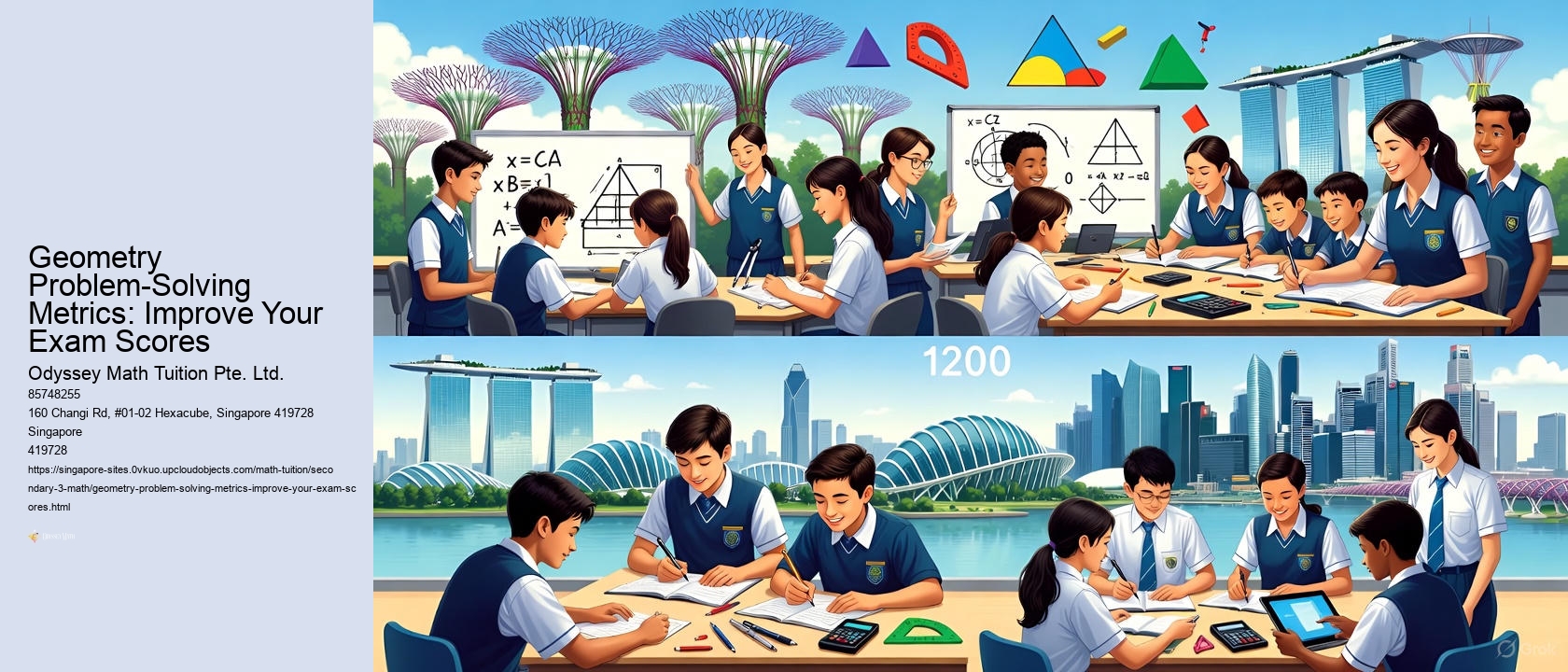
Geometry Problem-Solving Metrics: Improve Your Exam Scores
Introduction: Geometry Mastery for Sec 3 Success
So, your kid's in Sec 3, huh? Time flies leh! And you're probably thinking, "How ah? In the city-state's rigorous education structure, parents perform a essential function in leading their children through key assessments that shape scholastic trajectories, from the Primary School Leaving Examination (PSLE) which assesses foundational competencies in disciplines like mathematics and STEM fields, to the GCE O-Level assessments concentrating on intermediate proficiency in multiple subjects. As students progress, the GCE A-Level assessments necessitate more profound logical skills and discipline command, often deciding tertiary placements and professional trajectories. In today's competitive educational landscape, many parents in Singapore are seeking effective strategies to enhance their children's grasp of mathematical ideas, from basic arithmetic to advanced problem-solving. Establishing a strong foundation early on can greatly boost confidence and academic performance, helping students handle school exams and real-world applications with ease. For those considering options like secondary 3 math it's vital to focus on programs that highlight personalized learning and experienced guidance. This method not only resolves individual weaknesses but also cultivates a love for the subject, resulting to long-term success in STEM-related fields and beyond.. To stay updated on all facets of these countrywide exams, parents should check out formal information on Singapore test papers offered by the Singapore Examinations and Assessment Board (SEAB). This guarantees access to the latest curricula, examination timetables, registration specifics, and guidelines that correspond with Ministry of Education requirements. Regularly checking SEAB can aid families get ready efficiently, reduce doubts, and support their children in reaching peak outcomes during the challenging scene.. So many subjects, so little time!" Relax, breathe deep. We're here to talk about one subject that's super important, not just for their exams, but for their future: Geometry. Yes, that thing with the triangles and circles that might seem like a pain now, but trust me, it's a game-changer. We are here to discuss geometry problem-solving metrics and how to excel in Singapore Secondary 3 Math.
Think about it: Singapore's all about innovation, right? AI, robotics, you name it. And what's the backbone of all that fancy tech? Math! Geometry, in particular, helps develop spatial reasoning and problem-solving skills – exactly what those future tech jobs are gonna demand. So, mastering geometry isn't just about acing that Sec 3 Math exam; it's about setting your child up for success in a world that's increasingly driven by technology. It's the foundation for everything from engineering to computer graphics. Don't play play!
And let's be real, the PSLE is over, but the pressure cooker that is the Singapore education system doesn't just magically disappear. It just evolves! Secondary school is where the real foundational work begins, and a strong grasp of geometry and trigonometry now will pay dividends later, especially when they hit the JC years and beyond. We want them to do well in their 'O' Levels and 'A' Levels, right? Geometry is a key stepping stone. This article will delve into geometry problem-solving metrics and provide useful tips on how to excel in Singapore Secondary 3 Math.
Geometry and Trigonometry Essentials
Okay, so what exactly are we talking about when we say "geometry and trigonometry"? It's not just memorizing formulas (though that's part of it, kanchiong spider parents!). It's about understanding the relationships between shapes, angles, and distances. It's about visualizing problems and applying logical reasoning to solve them. These are crucial concepts in how to excel in Singapore Secondary 3 Math.
Key Concepts to Focus On:
Triangles: Congruence, similarity, Pythagoras' Theorem, area calculations.
Circles: Tangents, chords, angles in a circle, sector area, and arc length.
Trigonometry: Sine, cosine, tangent ratios, solving trigonometric equations, applications in 2D and 3D problems.
Coordinate Geometry: Lines, gradients, equations of lines, distance between points.
These aren't just random topics; they build on each other. A solid understanding of triangles is essential for tackling trigonometry, and trigonometry is crucial for understanding more advanced concepts later on. So, make sure your child has a strong foundation in these basics. This is critical to learn how to excel in Singapore Secondary 3 Math.
Fun Fact: Did you know that trigonometry has its roots in ancient astronomy? Early astronomers used angles and distances to map the stars and planets. So, when your child is struggling with sine and cosine, remind them they're basically doing rocket science!
Geometry Problem-Solving Metrics
Now, let's get down to the nitty-gritty: how do we measure progress and identify areas for improvement? It's not enough to just say, "My child needs to do better." We need concrete metrics to track their performance and guide their learning. Here are some key areas to focus on:
In the challenging world of Singapore's education system, parents are ever more intent on equipping their children with the abilities required to thrive in intensive math curricula, encompassing PSLE, O-Level, and A-Level preparations. Spotting early indicators of struggle in areas like algebra, geometry, or calculus can make a world of difference in fostering resilience and expertise over advanced problem-solving. Exploring dependable math tuition Singapore options can offer customized guidance that corresponds with the national syllabus, ensuring students obtain the boost they want for top exam scores. By focusing on engaging sessions and regular practice, families can assist their kids not only meet but go beyond academic goals, paving the way for prospective possibilities in competitive fields..
Accuracy: Are they getting the right answers? This seems obvious, but it's the most fundamental metric.
Speed: How quickly can they solve problems? Exam time is limited, so speed is crucial.
Understanding: Do they truly understand the concepts, or are they just memorizing formulas? Can they explain their reasoning?
Problem-Solving Strategies: Are they using effective strategies to tackle different types of problems? Can they identify the key information and apply the appropriate formulas?
Error Analysis: What types of mistakes are they making? Are they careless errors, or do they indicate a deeper misunderstanding of the concepts?
By tracking these metrics, you can identify your child's strengths and weaknesses and tailor their learning accordingly. Maybe they're great at geometry but struggle with trigonometry. Or maybe they understand the concepts but make careless errors under pressure. Knowing this will help you focus their efforts and get the most out of their study time.
Interesting Fact: The word "geometry" comes from the ancient Greek words "geo" (earth) and "metron" (measurement). It literally means "earth measurement," reflecting its origins in surveying and land division.
What are the key geometry topics covered in Singapore Secondary 3 math exams?
Key topics include angle properties of triangles and polygons, congruence and similarity, Pythagoras theorem, trigonometry (sine, cosine, tangent), circles (angles, tangents, chords), and mensuration (area and volume).
How can I improve my problem-solving speed in geometry questions?
Practice regularly, focusing on identifying key information and relevant theorems quickly. Memorize formulas and common geometric relationships. Work through timed practice papers to build speed and accuracy.
What are some common mistakes students make in geometry problems?
Common mistakes include misinterpreting diagrams, applying incorrect formulas, making algebraic errors while solving equations, and not providing sufficient justification for steps in a proof.
How important is drawing accurate diagrams in geometry problem-solving?
Drawing accurate, labeled diagrams is crucial. It helps visualize the problem, identify relationships between angles and sides, and avoid errors in calculations.
What strategies can I use to tackle challenging geometry problems?
Break down complex problems into smaller, manageable steps. Look for congruent or similar triangles, apply relevant theorems, and consider using auxiliary lines to create new relationships.
How can tuition help my child improve their geometry problem-solving skills?
Good tuition provides personalized instruction, targeted practice on weak areas, and strategies for tackling challenging problems. Tutors can also offer exam-specific tips and build confidence.
Are there any online resources that can help with geometry problem-solving?
Yes, many websites and apps offer geometry tutorials, practice problems, and interactive simulations. Khan Academy, GeoGebra, and YouTube channels dedicated to math education are excellent resources.
How do I effectively use past exam papers to prepare for geometry questions?
Review past exam papers to identify common question types and difficulty levels. Practice solving the problems under timed conditions, and analyze your mistakes to understand areas for improvement.