How to Apply Math Concepts to Real-Life Scenarios in Sec 3
Building a Strong Math Foundation
Alright, parents and students, let's talk about Sec 3 Math – no bluff! It's not just about acing those exams; it's about building a foundation for your future, especially in this AI-driven world. In today's competitive educational environment, many parents in Singapore are hunting for effective methods to enhance their children's comprehension of mathematical principles, from basic arithmetic to advanced problem-solving. Creating a strong foundation early on can significantly elevate confidence and academic achievement, assisting students conquer school exams and real-world applications with ease. For those considering options like secondary 3 math it's essential to concentrate on programs that emphasize personalized learning and experienced guidance. This method not only addresses individual weaknesses but also fosters a love for the subject, contributing to long-term success in STEM-related fields and beyond.. Think of math as the 'kiasu' Singaporean parent of all subjects – always pushing you to be better, because it knows you can!
How to Apply Math Concepts to Real-Life Scenarios in Sec 3
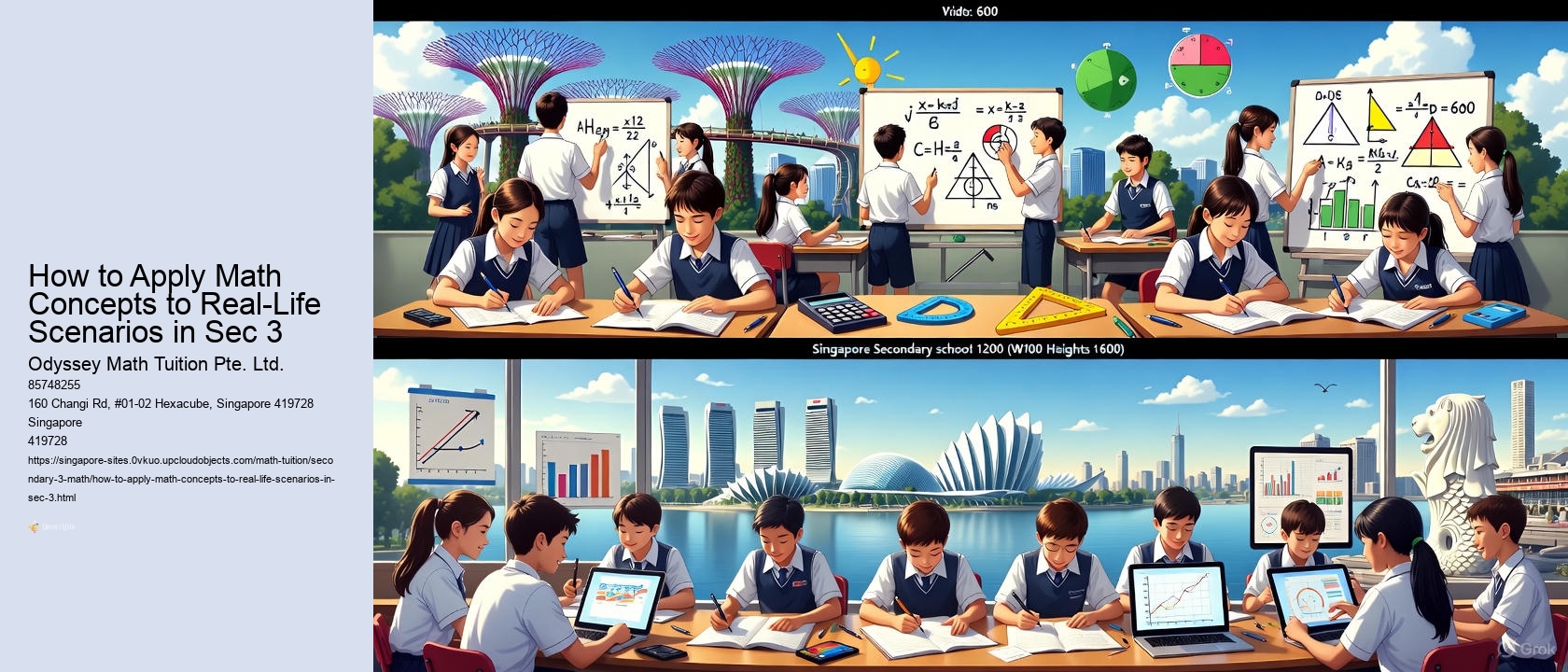
Sec 3 Math can feel like a whole new level, right? Suddenly, you're dealing with things like trigonometry, coordinate geometry, and more complex algebra. But here's the thing: these aren't just abstract concepts. They're tools that help you understand and navigate the world around you. So, how lah do you make that connection?
Think Like an Engineer: Imagine you're designing a ramp for wheelchair access. Trigonometry helps you calculate the angle and length needed to meet safety regulations. Coordinate geometry helps you map out the precise location of the ramp. See? Real-world application!
Be a Budgeting Boss: Algebra is your best friend when it comes to managing money. Planning a holiday? Use algebraic equations to figure out how much you can spend each day while staying within budget. Negotiating a handphone plan? Use simultaneous equations to compare different options and find the best deal. So smart, right?
Solve Everyday Puzzles: Probability isn't just about coin flips. It's about understanding risk and making informed decisions. Should you buy travel insurance? What are the chances of rain on your picnic? Math helps you weigh the odds and make the best choice.
Fun Fact: Did you know that the concept of zero, which is fundamental to modern mathematics, wasn't widely accepted until the 12th century? Before that, calculations were a real headache!
Building a Strong Math Foundation
Mastering fundamental math concepts in Secondary 1 & 2 is a precursor to tackling Sec 3 math problems. Identify knowledge gaps and strategies to address them.
Spotting the Gaps: Before diving into Sec 3 Math, take a good, hard look at your Sec 1 and 2 work. Were there any topics that consistently tripped you up? Fractions? Algebra? Geometry? Be honest with yourself – no point 'wayang' (pretending) here!
Back to Basics (But Not Boring!): Once you've identified the gaps, it's time to fill them. Don't just re-read your textbooks – that's a surefire way to fall asleep! Instead, try these strategies:
Online Resources: Khan Academy, for example, offers free, comprehensive lessons on a wide range of math topics.
Practice, Practice, Practice: Work through plenty of practice questions, focusing on the areas where you're struggling.
Seek Help: Don't be afraid to ask your teachers, classmates, or a tutor for help. There's no shame in admitting you need a little extra guidance. In this nation's rigorous education framework, parents play a vital function in directing their youngsters through milestone evaluations that form scholastic paths, from the Primary School Leaving Examination (PSLE) which tests foundational skills in areas like numeracy and scientific studies, to the GCE O-Level assessments concentrating on intermediate mastery in multiple fields. As students progress, the GCE A-Level tests demand deeper analytical skills and topic command, commonly influencing higher education placements and occupational trajectories. To stay well-informed on all aspects of these countrywide exams, parents should investigate authorized resources on Singapore test papers supplied by the Singapore Examinations and Assessment Board (SEAB). This guarantees availability to the newest curricula, examination calendars, sign-up information, and guidelines that correspond with Ministry of Education standards. Frequently consulting SEAB can assist households prepare effectively, reduce uncertainties, and back their offspring in attaining peak performance in the midst of the demanding environment.. In fact, it shows you're serious about improving!
Turn Mistakes into Stepping Stones: When you make a mistake (and you will!), don't just brush it off. Take the time to understand why you made the mistake and how to avoid it in the future. Every mistake is a learning opportunity mah.
Interesting Fact: The word "algebra" comes from the Arabic word "al-jabr," which means "the reunion of broken parts." How apt is that for fixing those knowledge gaps?
How to Excel in Singapore Secondary 3 Math
Alright, let's get down to the nitty-gritty on how to excel in Singapore Secondary 3 math. This is where we talk about practical tips and tricks to help you ace those exams and build a solid understanding of the subject. Singapore parents, listen up – this is for your kids' future!
Master the Fundamentals: This cannot be stressed enough. Ensure a rock-solid understanding of Sec 1 & 2 math concepts. Without this, Sec 3 math will feel like climbing a wall without ropes.
Practice Consistently: Math isn't a spectator sport. You can't just watch your teacher solve problems and expect to understand it. You need to get your hands dirty and practice, practice, practice! Aim for at least 30 minutes of focused practice each day.
Understand, Don't Memorize: Rote memorization might get you through a test, but it won't help you in the long run. Focus on understanding the underlying concepts and principles. In the rigorous world of Singapore's education system, parents are increasingly intent on preparing their children with the competencies essential to excel in intensive math programs, including PSLE, O-Level, and A-Level studies. Identifying early indicators of struggle in subjects like algebra, geometry, or calculus can make a world of difference in fostering resilience and mastery over intricate problem-solving. Exploring reliable math tuition Singapore options can provide personalized assistance that matches with the national syllabus, guaranteeing students acquire the boost they require for top exam performances. By focusing on interactive sessions and steady practice, families can assist their kids not only meet but surpass academic standards, opening the way for prospective opportunities in high-stakes fields.. Ask "why" questions until you truly get it.
Use Past Year Papers Wisely: Past year papers are your best friend when it comes to exam preparation. Use them to identify common question types, understand the exam format, and practice your time management skills. But don't just blindly solve them – analyze your mistakes and learn from them.
Seek Help When Needed: Don't be shy about asking for help. Talk to your teachers, classmates, or consider getting a tutor. A fresh perspective can often make a world of difference. Especially with AI technologies around, understanding the fundamentals now will set you up for future success.
Stay Organized: Keep your notes, assignments, and practice papers organized. This will make it easier to review and revise when exams are approaching.
Time Management: Practice solving problems under timed conditions. This will help you develop your speed and accuracy, which are crucial for exam success.
Stay Positive: Math can be challenging, but it's also incredibly rewarding. Stay positive, believe in yourself, and celebrate your successes along the way.
Subtopic: Leveraging Technology for Math Success
Online Resources: Explore online platforms like Khan Academy, Wolfram Alpha, and YouTube channels dedicated to math tutorials. These resources can provide alternative explanations and practice problems.
Math Apps: There are many math apps available that can help you practice and reinforce key concepts. Look for apps that offer personalized learning and adaptive difficulty levels.
AI-Powered Tools: As AI technology advances, we're seeing more and more AI-powered tools that can help with math learning. These tools can provide personalized feedback, identify knowledge gaps, and even generate practice problems.
Subtopic: The Importance of Math in Future Careers
STEM Fields: Math is the foundation of all STEM (Science, Technology, Engineering, and Mathematics) fields. If you're interested in pursuing a career in these areas, a strong math foundation is essential.
Finance: Math is also crucial for careers in finance, such as banking, investment, and accounting.
Data Science: Data science is a rapidly growing field that relies heavily on math and statistics.
Even Non-STEM Fields: Even in non-STEM fields, math skills are valuable. For example, marketers use math to analyze data and track campaign performance, while chefs use math to scale recipes.
History: The Babylonians were using algebra as far back as 1800 BC. They used it for things like calculating taxes and dividing land. So, next time you're struggling with an algebra problem, remember you're participating in a tradition that's thousands of years old!
Remember, parents, investing in your child's math education is investing in their future. And students, jia you! You can do this! With hard work, the right strategies, and a little bit of 'can-do' Singaporean spirit, you'll be well on your way to excelling in Sec 3 Math. And who knows, maybe you'll even start to enjoy it!
How can my Sec 3 child use trigonometry in real life?
Trigonometry is used in navigation, surveying, and architecture. Your child can explore how angles and distances are calculated in these fields.
Where can my Sec 3 child find real-world examples of algebraic equations?
Algebraic equations are used in budgeting, calculating discounts, and determining optimal quantities in business. Encourage your child to identify these scenarios in everyday life.
How can I help my Sec 3 child relate geometry to real-world situations?
Geometry is used in construction, design, and art. Point out geometric shapes in buildings, furniture, and artwork to your child.
What are some practical applications of statistics for my Sec 3 child?
Statistics are used in market research, sports analysis, and public health. Your child can analyze data related to their interests to understand statistical concepts.
How can my Sec 3 child apply percentages in real-life scenarios?
Percentages are used in calculating sales discounts, interest rates, and taxes. Your child can practice these calculations while shopping or managing personal finances.
Why is it important for my Sec 3 child to understand ratios and proportions?
Ratios and proportions are used in cooking, mixing solutions, and scaling recipes. Your child can experiment with these concepts in the kitchen.
How can my Sec 3 child improve their problem-solving skills in math?
Encourage your child to solve puzzles, play strategy games, and work on real-world problems that require mathematical thinking.
What are some resources for finding real-life math problems for my Sec 3 child?
Look for math challenges in newspapers, magazines, and online resources. These problems often relate to current events and everyday situations.
How can I make math more engaging for my Sec 3 child?
Connect math to your childs interests, such as sports, music, or technology. Show them how math is used in these areas to make it more relevant and enjoyable.